Pillar II


Corporate Accountability
Companies are tasked to ‘respect’ human rights wherever they operate. This has been their role since the signing of the Universal Declaration. In 2011, the Office of the High Commissioner of Human Rights achieved unanimous endorsement of the UN Guiding Principles on Business and Human Rights, clarifying how “respect” is demonstrated. The term “human rights due diligence” (HRDD) was coined to describe core tasks performed by rights-respectful companies:
(1) Making public commitments to do no harm to affected people in Human Rights Policies.
(2) Evaluating impacts to demonstrate that commitments are being met through Human Rights Due Dilligence (HRDD): Risk Screening & Scoping; In-Depth Impact Assessment; and Meaningful Engagement.
(3) Taking Action to Remedy harms whenever they are identified.
(4) Advancing human rights performance over time as benchmarked by Maturity Matrices.
How we help companies respect human rights
- Human Rights Policies
- Scoping of Human Rights Risks
- In-depth Assessment of Impacts on Human Rights
- Actions and Remedies
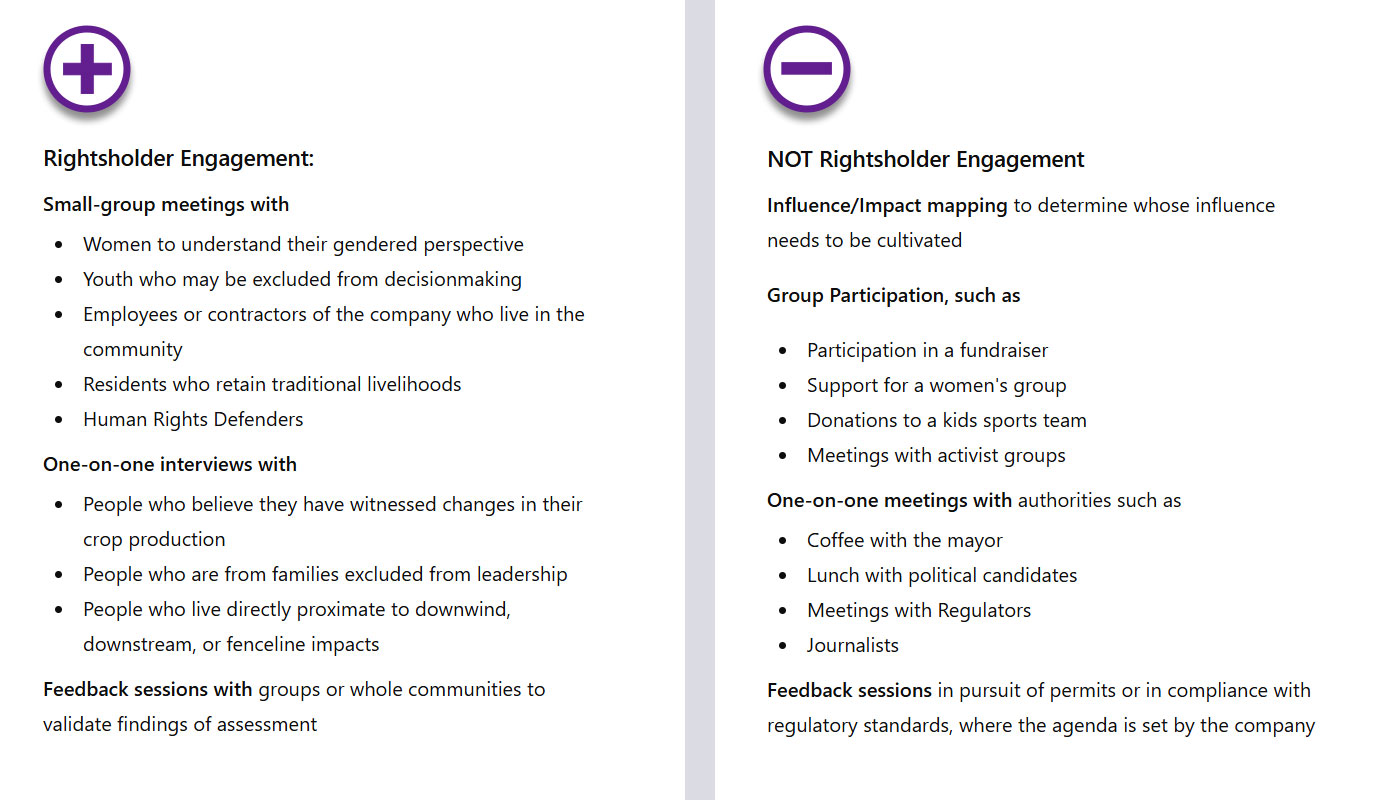
- Meaningful Engagement
- Human Rights Maturity
Corporate human rights policies are internal governance documents that lay out how a business operates. We have produced a sample policy but urge you to look at the strong existing policies of some companies
01
The scoping of human rights risk and in-depth assessment of impacts are part of a continuum of effort. We provide detailed guidance on these processes. For examples, visit the Human Rights Due Diligence page
02
In-depth assessment is the process undertaken once risk scoping identifies actual and potential human rights impacts that may need remediation. Examples of in-depth human rights impact assessment are available on the Human Rights Due Diligence page. The documents below offer step-by-step methodologies for undertaking the key components of assessment.
03
Indicators benchmarking adverse human rights conditions and setting targets for improvement and remediation over time will need to be established on a case-by-case basis, contingent on the identified impacts and rightsholders. Sometimes these are quantitative or qualitative; often they are a mix. For example, if assessment finds that water quality parameters include sedimentation from construction, then remediation will document reduced turbidity (quantified), removal of banked sediment (quantified and qualified), and improved navigability in waterways (qualified, verified by waterway users). Additional remedies can be linked to outcomes from grievance mechanisms as laid out under Pillar III
04
Companies can only remedy harms when they have identified the affected people and the root causes of harms. Recommendations and actions are rooted in the perspectives and knowledge of affected people
05
Human rights maturity describes a company’s progress in systematically and effectively improving its human rights performance. Due diligence helps a company identify and manage risks and impacts; maturity helps a company to have fewer impacts to manage.
Maturity matrices benchmark a company’s success in embedding human rights into its operations, representing a progression. Most companies evolve incrementally, whether in operational controls or in other business functions. They improve from reactive to structured, risk-aware, integrated, accountable, and high-functioning. Approaches to human rights generally begin ad-hoc, in response to regulatory evolutions and improve with care, competency and resourcing. They expand, unevenly, as companies grow more aware of their human rights impacts. A maturity matrix helps companies recognize the multiple dimensions of their human rights responsibilities, to target specific areas of growth and improvement over time.
Clear Governance: Board and executive oversight of human rights risks.
Meaningful Stakeholder Engagement: Direct dialogue with workers, communities, and vulnerable groups
Integrated Due Diligence: Ongoing identification, prevention, mitigation, and tracking of impacts that feed into broader corporate decisionmaking
Effective Grievance Mechanisms and Vertical Accountability: Accessible, trusted, and responsive complaint systems
Rigorous systems to protect rights in the Workforce, Community and Supply Chain: Implemented in partnership with Human Resources; Health & Safety, Environment; Procurement; Sustainability & Social; Security; and Operations Teams
Transparent Reporting, Monitoring and Management: Clear disclosure of risks, actions taken, and outcomes achieve
06